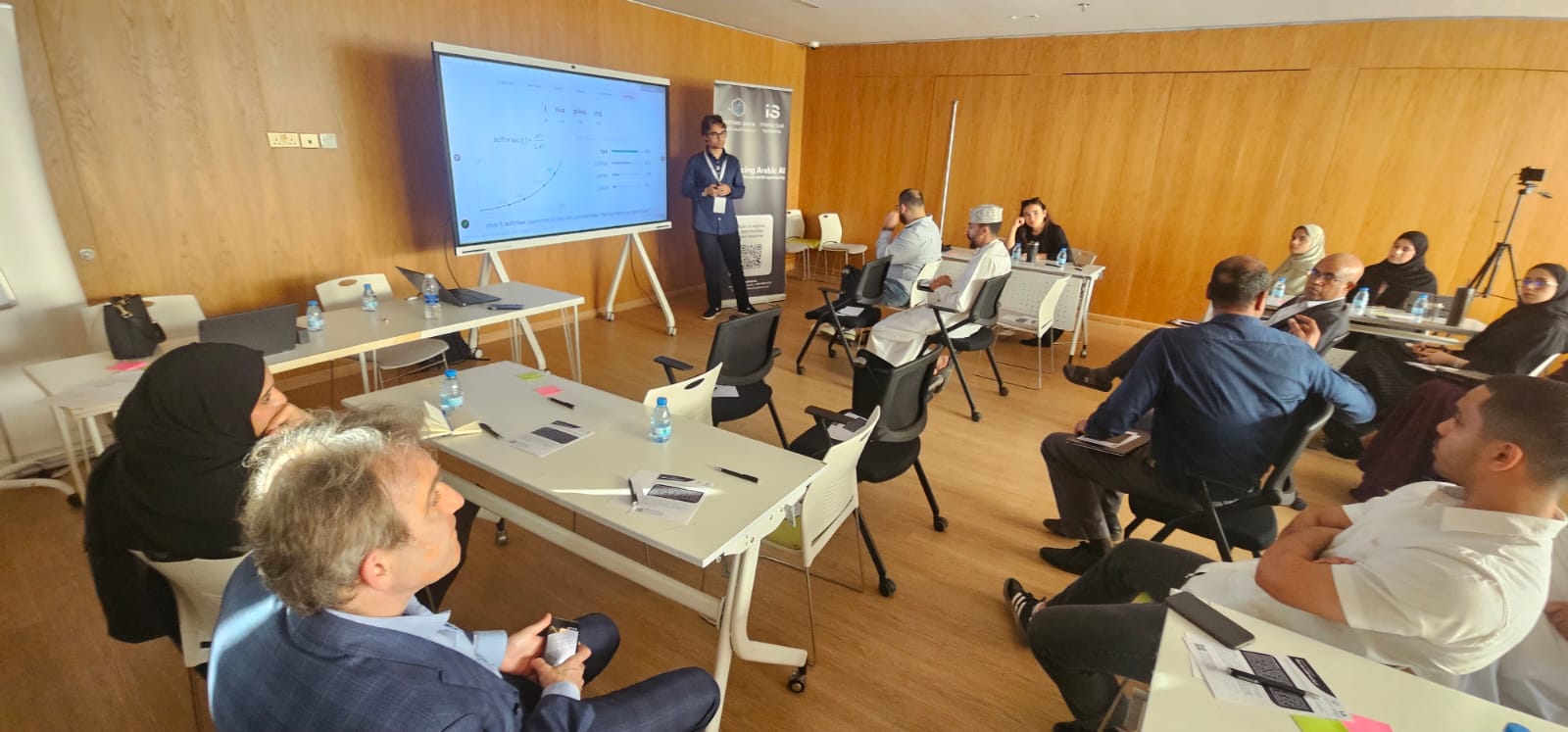
On August 25, 2026, Future Data hosted “Why Does AI Struggle with Arabic?”, a two-hour technical workshop created with Intellectual Systems / Markov Lab. The session was led by Artiom Lipinski, CTO at Intellectual Systems and researcher at the A.A. Markov Laboratory, with Houda Berrada Meziane facilitating and Future Data founder Amna AlSinani hosting the discussion.
The workshop was designed as a practical deep dive: first explaining how modern large language models work, then showing why Arabic creates unusually hard technical problems, and finally widening the lens to applied AI systems beyond chatbots.
A full house at Future Data’s ‘Why Does AI Struggle with Arabic?’ workshop — in partnership with Intellectual Systems
From Tokens to Text
The first part of the seminar built the foundation. LLMs do not read text as words; they process tokens, which are numeric IDs drawn from a fixed vocabulary. Those tokens become embedding vectors, positional information is added, transformer layers reshape the representation, and the final layer produces probabilities for the next token. Generation is simply this cycle repeated again and again: predict, append, predict.
That architecture makes tokenization more than a preprocessing detail. Tokens are billed, stored in context, and processed individually. If Arabic words are split into too many fragments, the same idea costs more, takes more context, and becomes harder for the model to understand.
The Three Arabic Challenges
Artiom framed the Arabic problem around three constraints: morphology, harakat, and data. Arabic has millions of possible word forms, yet common model tokenizers often dedicate far fewer vocabulary entries to Arabic than to English. The result is fragmentation: Arabic expressions become longer token sequences, which weakens both efficiency and semantic precision.
The team’s Gulinar research explores one response: extending an existing Qwen model with roughly 50,000 additional Arabic tokens. The new embeddings are initialized by averaging the embeddings of older sub-token pieces, then trained through a frozen warm-up phase before full-model training on large Arabic corpora.
Treating Harakat as a Signal
Harakat create another problem: a diacritic can change pronunciation and meaning, but representing every letter-and-diacritic combination inside the tokenizer would explode the vocabulary. Instead, the team separates the base text from the diacritic layer. Their submitted research reserves part of the embedding space for harakat information and encodes it through a rotation-inspired method, borrowing from the same family of ideas used for positional embeddings.
The reported outcome is notable: no token corruption, strong diacritization fidelity on a smaller model, and lower perplexity when diacritics are present — suggesting the model benefits from the signal rather than merely decorating Arabic text after the fact.
Why Data Is Still the Hardest Part
Even strong architecture cannot solve the Arabic LLM problem without data. The workshop compared three imperfect strategies: mining the web for clean Arabic text, translating English datasets into Arabic, and distilling examples from larger teacher models. Each helps, but each comes with tradeoffs in quality, voice, cost, and cultural fit.
AI Beyond the Chatbot
The final section pushed back on the idea that every AI project should be wrapped in ChatGPT. Intellectual Systems shared applied examples including Arabic OCR pipelines that separate letters from diacritics, flow optimization for infrastructure and logistics, and financial anomaly detection with time-series models and geographic dashboards. The broader message was clear: AI is not one technique. The right system may be a language model, a computer vision pipeline, an optimizer, or a classical machine-learning model.
Key Takeaways
Arabic-capable AI needs Arabic-aware tokenization, morphology, diacritics, evaluation, and data pipelines.
Translated data is useful, but overuse can make models sound unnatural and culturally distant.
Agentic RAG, domain validators, and smaller specialized models can be more practical than one large general model.
As Amna AlSinani noted, technical challenges create interesting opportunities — especially for researchers, public-sector teams, banks, call centers, and organizations building Arabic-first AI in Oman and the region.
Native Slides Companion
The animated presentation framed the workshop around one core question — “But why does AI struggle with Arabic?” — and translated the technical material into a visual journey from tokens and embeddings to Arabic morphology, harakat, Gulinar, and applied AI systems.
Presentation Flow
Opening frame: the seminar introduced the joint workshop by Future Data and Intellectual Systems, featuring Artiom Lipinski’s research background in AI, deep learning, and Arabic NLP.
LLM basics: the deck visualized how text becomes tokens, how vocabularies map tokens to IDs, how embeddings store meaning as vectors, and how generation repeats one next-token prediction at a time.
Tokenization problem: the slides showed why simple letter-level vocabularies are inefficient, and why learned tokenizers still under-serve Arabic compared with English.
Arabic-specific barriers: morphology, orthographic ambiguity, and data scarcity were presented as the three main reasons Arabic remains difficult for LLMs.
Gulinar research: the deck explained the team’s Arabic-adapted model work, including expanded Arabic vocabulary, warm-up training for new embeddings, and continued pretraining from Qwen3 models.
Harakat solution: the presentation separated base Arabic text from diacritics, treating harakat as an additional signal rather than forcing every marked form into the tokenizer.
Beyond LLMs: the final section broadened AI into OCR, flow distribution, and price anomaly detection, reinforcing that the right AI method depends on the problem.
Because the original file is an animated HTML deck, this native section preserves the deck’s content as editable blog material while keeping the post publishable inside Framer.
Watch and Learn More
Watch the workshop recording: Zoom recording
View the animated slide deck: But why does AI struggle with Arabic?
Explore the seminar companion: Future Data links and resources
Start with the fundamentals: 3Blue1Brown’s neural networks series
Go deeper with: Hugging Face’s LLM Course and Attention Is All You Need
For Arabic NLP: Arabic models on Hugging Face, CAMeL Tools, and the Arabic NLP conference archive.
Future Data and Intellectual Systems are open to collaboration on Arabic and Omani LLMs, applied AI systems, and evaluation opportunities for Gulinar. The workshop closed with a practical invitation: bring real use cases, research questions, and regional language needs — because progress in Arabic AI will come from building, testing, and learning together.
5 min read